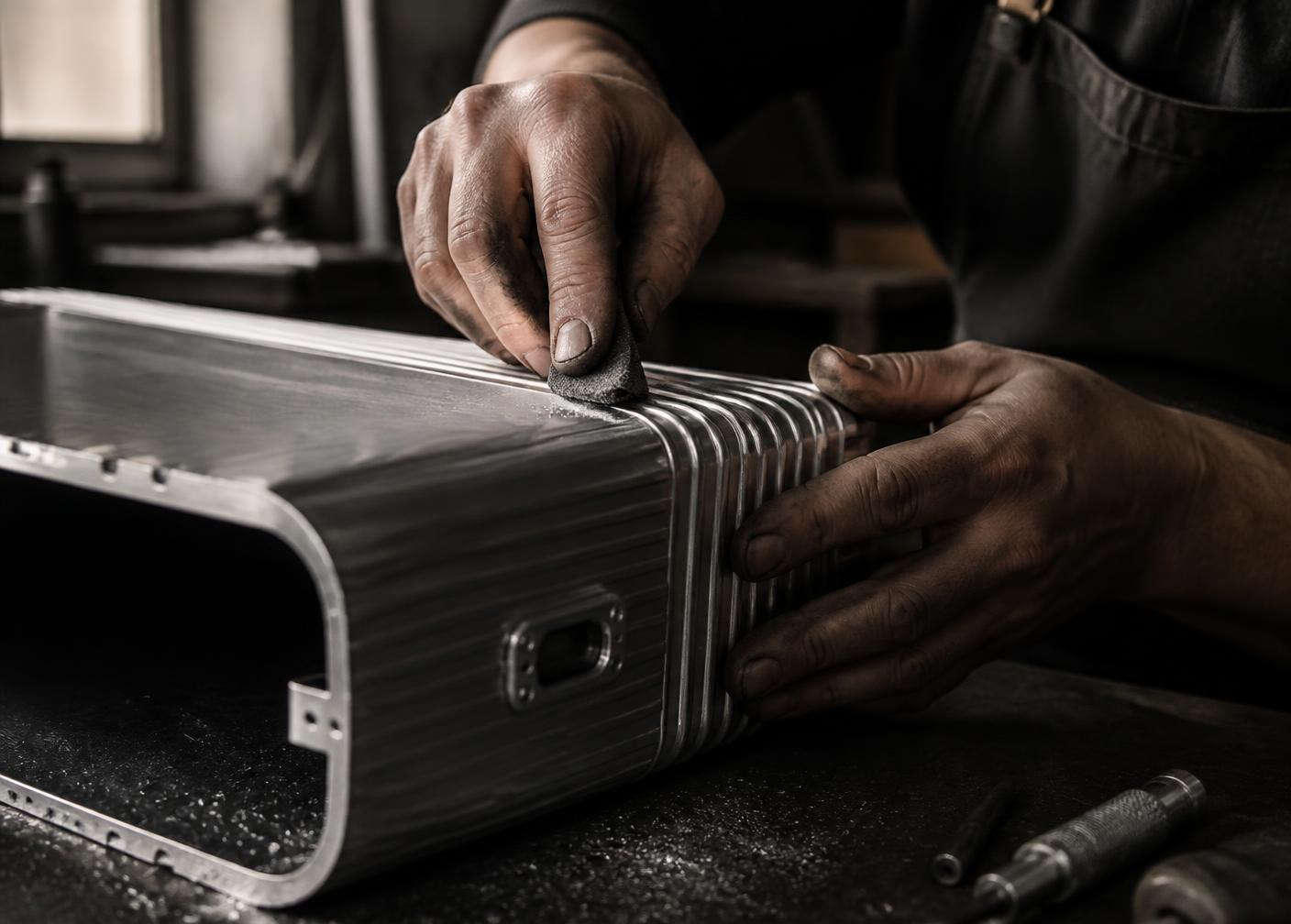
A WHREVR shell begins as a flat coil of aluminium, 1.2 mm thick, wide enough to wrap a person. It leaves the atelier eleven days later as a case that will outlive the person who buys it.
First hand: the press. The grooves are cold-formed in a single pass — not rolled in stages — because a single pass keeps the grain of the metal continuous down the length of the shell. Continuous grain is why a WHREVR case dents rather than splits.
Third hand: the anodising bath. Colour here is not paint. It is oxide grown into the surface at a controlled voltage, which is why the finish cannot chip off — there is nothing sitting on top of the metal to chip.
Sixth hand: the lock. Integrated TSA mechanisms are seated by hand, tested twenty times, then torque-marked. Seventh and eighth: lining and wheels. The multiwheels are spun for ninety seconds each and listened to; anything with a tick is rejected.
Ninth hand: the inspection light. One person, one raking lamp, one slow pass along every groove. Roughly one shell in fourteen goes back.
We do not describe this to justify a price. We describe it because you should know exactly what you are lifting into an overhead bin.